Monday, July 11, 2011

My Trip To Little Rock: Tuesday at KTHV

I must say, this day was great and it wasn't over yet!  Jerry and I went to see the "old" KAAY studios at KTHV, where Jerry worked both in radio (KAAY) and in TV (KTHV), both times in the same office!  While at KAAY, it was while he was Music Director, at KTHV, I believe while he was in weather.

I caught Jerry as we were about to walk across the road:


Upon entering the lobby, Jerry called up to one of his associates (Jerry is still in the business selling advertising) and we were let in.  We were met by several people who knew Jerry well and were given a tour by Lana Campbell, a great lady who is also a friend of Clyde Clifford.  Lana sent in a couple of photos up and down the famous hallway where Jerry and his radio associates skateboarded and terrorized the TV people...they're further down the post....

We almost forgot about David B., so we ran downstairs and let him in (almost when the tour was over!).  We went back upstairs and Lana gave him a refresher tour.  The famed studio (more later) where everyone operated was now closed and locked, full of computer equipment and it was a touchy matter of gaining access, so that door was never opened.  However, the control room next door was opened to us.  It was a little cluttered, but Jerry showed me the glass window (now blocked off from the other side) where the engineer would take his cues and would cue the deejay.  David B. proceded to clown it up at the mike, but declined any photos!

Now, for the promised "more later" story on ther famed studio:  I had Jerry pose on the landing just outside the door of the studio, where the deejays used to be able to open the door and look down the stairs at the Blue Goose "Lounge":


I didn't use flash because I didn't want this particular photo to wash out, for a reason...not because I didn't want Jerry in it!

If you remember stories about Howard Watson, who was "Ken Knight" and how he conjured stories about how elegantly-dressed patrons arrived in limosines and dined on great food and wine, all the while having a sound track playing of glasses and silverware tinkling, then you'll get that magical picture he aired over nearly half the U.S. continent.  Folks from Wisconsin would call the Blue Goose and want to book a table!

Here are several links for you to revisit and enjoy:

http://mighty1090kaay.blogspot.com/2009/10/blue-goose-on-timeless-tracks.html

http://mighty1090kaay.blogspot.com/2009/10/more-goose-stories-from-jerry-simssonny.html

http://mighty1090kaay.blogspot.com/2009/10/jerry-sims-jim-clark-on-blue-goose.html

And Jerry's skateboarding story:

http://mighty1090kaay.blogspot.com/2009/10/of-skateboards-and-blue-goose.html

Being the romantic, I could only imagine whay the Blue Goose looked like.  I doodled this picture I had in mind:


As I imagined, looking through the window, late at night, with all the lights off except those in the studio.

Can't you just imagine Jerry and others seeing someone walking down the alley and calling that phone booth, telling them, "The money's in the dumpster" in a hushed voice, then hanging up.  Sometimes, Jerry said, the person would look around, expecting a Mafia "hit", others would actually look in the dumpster!

On slow nights, Jerry and others had bets going as to how many rats would enter and exit the dumpster.  In the picture, I bet on two for the time I took to sketch it.  Did I win or lose, Jerry?

Thanks to Lana Campbell, friend of Jerry and Clyde Clifford, she sent some shots of the aforementioned famed hallway:


In the second picture, you'll see the stairwell on the left, which is directly across from the famed studio where The Greats spun their magic for us...and just down the hall, second door to the left was Jerry Sims' office when he was KAAY's Music Director and later the KTHV weather man!

Can't you see a young Jerry/"Sonny Martin" skating down these halls, turning the corner at the end of the hall in the first picture and terrorozing TV executives and Accounting people?  "Those darned radio people!!!!"

In addition to meeting Jerry's nephew David and other people, I got to see the Weather Garden and meet Joey the Weather Cat!

Onward, to meet with Barry Mac, who was about to get off from work; we met him at the local Cadillac dealership, where he was to pick up his car.  David B., Barry's former boss, went with us to see Barry again.


I believe this was the first time Barry and Jerry had met.  Barry was giving Jerry and David B. the nutshell story of what went on after KAAY went to a religious format.  Barry stayed on until a few years ago and was in a KTHV video that Craig O'Neill did on KAAY:

http://mighty1090kaay.blogspot.com/2010/01/kaay-feature-on-little-rock-tv.html

Well, after the meeting of these Greats above, Jerry had a softball game to play and David B. took me back to my motel.  It had been a great Tuesday, April 19, 2011 with the guys and David B. warmly expressed his "see ya later" (I hate "good bye").  We were all very tired after a very full, fantastically rewarding day and I expressed my concern for David B.'s safety back home, as the front started to roll in.  Fortunately, he was driving home ahead of the front, as it was to the west of Little Rock as he rocketed south.

Sitting at the motel, awaiting my wife and daughter to arrive from the diamond fields, waiting to go eat and resting (it was raining too hard by this time to walk next door to an eatery), I pondered it all....

Bud S. (staceys4@hotmail.com)

Thursday, July 7, 2011

My Trip To Little Rock: Tuesday, With Felix McDonald

We finally had to say goodbye to the transmitter site; there was so much more to do and places to go and we were trying to beat the incoming bad weather.  I had called Felix the week before to ask permission to drop by and he graciously consented.  Well, as David B. and son Matt, Jerry and I drove a half-mile down the road, we pulled up and the McDonalds were sitting on the porch as if they were expecting us!  We got out, greeted by the dogs and shook hands all around.  I must say that David B. reverently shook Felix's hand and bent down to give this great man a hug.  We all feel the same way about Felix!

Being invited inside, I got Jerry and David B. to pose with Felix:


A bunch of handsome fellers, yes?

David B. had to get his son back to Little Rock to his family and said his "see ya laters" all around, promising to visit Felix at a later date.  Jerry and I went in with the McDonalds for an hour long chat.  Jerry knew their daughter and son-in-law and they had a nice conversation, while Jerry passed around some materials he'd brought along to reminisce with Felix.

We got to talking about how, when Felix went to Texas, Pat Walsh chartered a jet to bring him back to Wrightsville to fix the transmitter when no one else could.  Felix said that Pat met him at the airport and drove like mad to the transmitter site.  Felix had a few choice words about the drive that we won't relate here, but it was a wild ride.

When they arrived, Felix went upstairs and was met by Cecil Suitt (who was the engineer for KTHS and for KAAY after the change-over).  Cecil said, "I betcha ya can't fix this one, boy!"  Felix looked things over and saw where they (Cecil and other engineers) had taken some parts out of the transmiter.  It took him about twenty minutes to put them all back, then asked one of the guys to hand him a broom..  He reached in with the wooden handle, pushed a contactor back in place and the transmitter fired right up!  We all had a good laugh at Felix's story.

I believe a version of this was related on this blog by Dave M. awhile back, but I cannot readily find the link....

Felix got up and walked over to a book case and came over to me, quietly handing me this commendation from Wayne Moss, Operations Director:


To the best of my research, I believe this happened in 1971, as Wayne didn't put the year on the page.

I'd noticed that, since his stroke, Felix was having a little trouble with recent memory, but was clear as a bell with memories of long ago.  Nonetheless, we had good conversation relating to the blog and also Ham radio in general.  He wants to get back on the air, so maybe we'll be fortunate to schedule a chat- I certainly hope so!

I had a new video camera which I wasn't very familiar with; I finally got things to work on it and got what I thought was several minutes of him telling the story about fixing the transmitter.  Little did I realize that the batteries were low and I only got less than a minute.  Maybe we can get this linked somewhere down the road for you to see Felix and Lois McDonald in their own home, speaking with Jerry Sims.

Time was slipping up on us, so we had to finally leave; we had to reunite with David B. back in Little Rock and try to catch up with Barry Mac, as well.  As we were leaving, Felix practically pushed past me, grabbing Jerry by the arm.  He stood face-to-face with Jerry and said, "The Jerry Sims I knew back then and you now are two different people- I just realized who you were!"  I wish I'd have gotten a picture or video of that touching moment....

With handshakes all around and promises to keep in touch, we left the McDonalds, a wonderful, sweet and hospitable couple; there's not many people like them any more.

As we drove back down the road, I quickly changed the batteries in the video camera and Jerry stopped by the transmitter one more time for me to get about a minute of video.  Hopefully, we can get it linked for you to enjoy a live view of the KAAY transmitter building.

Next, a visit to an old KAAY studio location at KTHV!

Bud S. (staceys4@hotmail.com)

Wednesday, July 6, 2011

Glaspie B. Dillard, 1917-1920‏

(This is a great account by David B. Treadway about when we were looking for Glaspie...bs)


During our pilgrimage to the KAAY transmitter site on April 19, 2011, Jerry Sims, Bud Stacey and I walked among the three towers in a field of tall grass and crawdad holes. Though not as pronounced as inside the building, there were signs of the sad neglect that has befallen The Mighty 1090. Counterpoise wires drooped when they should have been tight. The conduit that contained the feed lines to the west tower lay broken on the ground, thanks to the recent work of copper thieves. And the grass was high and ragged, years since Felix McDonald grazed cattle there.

I was hunting the tombstone of little Glaspie Dillard under that west tower. You've seen a couple of references to his name here on the Blog--and there's been a bit of controversy about him. Well, on this fine afternoon, I had witnesses with me. We were going to look at that tombstone and read the name of the child who had been buried in that field ninety years ago. There would, at last, be pictures of his marker and what little we know of his story would be told.

We fanned out and searched a good while to the north of the west tower, which is where I remember seeing the stone in 1971. It had stood almost upright, leaning maybe fifteen degrees back toward the building, with Glaspie's name and span facing roughly south. But we couldn't find a trace of it, sitting up or lying down. And here came the questions: had it fallen at last and been overgrown by the grass? Had Dillard descendants finally come to claim it? Had it been removed in an effort to damp down questions? Did I simply not remember its location--or had it never been there at all?

We looked for a bit longer. Then, deciding that it was just another lost trace, ambled back to the transmitter building. That was when Frank, the Citadel engineer, asked us if we had seen the tombstone! I told him we'd been unable to locate it, and he said, "Come on, I'll show you." So we piled into his four-wheel-drive pickup, Bud and I riding on the tailgate as country boys will do.

Back to the west tower we went--and Frank led us to its south side. The others saw the stone before I did: flat on the ground, lower third broken across and marked by a piece of rebar that had a cultivator foot welded to it, a Radio Cross to designate a grave. Except that the grave wasn't where it was supposed to be. I remember it being on the north side of the tower. But who's to say what happened to the headstone and its companion footstone (which I had never noticed) in the stretch of forty years? Vandals could have smashed it at the same time they decided to move it.

And what happened to little Glaspie B. Dillard in 1920? There was an especially nasty strain of influenza in Arkansas at the time. Was that what took him out? Was it some dreadful farm accident? Was he trampled by a horse or bitten by a cottonmouth? Did he live long enough to have any fun at all? What became of his parents? Did he have brothers and sisters to miss and to mourn him? Where did his family go? Did his death just suck all of the life out of them, forcing them to move away and try to forget the heartbreak?

The story goes that the proposed site for the KTHS transmitter relocation from Hot Springs was a cemetery, but the location was so prime for an AM facility--so perfectly matched to the specs--that family members were contacted and the graves were relocated. Except for Glaspie's. And there he remained while towers were erected and copper ground straps were laid above his little face. Sometime in 1952, some engineer threw a great big switch and fifty thousand watts of energy hit the earth that held a child's coffin. I'll bet he ain't slept a good night since.

I asked Frank if he had any Native American blood and he said "No." So he might not understand that that transmitter site was put in on a burial ground. There are prayers and rituals that need to be undertaken before you disturb such a sacred place--if you do it at all. I'm not sure that these were done, despite what I take to be the Cherokee ancestry of one of the engineers of the time.

Just before we left the west tower, Frank said, "Sometimes when the Moon is right, I can hear a three-year-old child crying out here."

David B. Treadway
Holiday VII
The Last PD

Tuesday, July 5, 2011

Glaspie, Et. Al. By Dave M.

A GREAT rendition of the Glapsie story, and thanks for the photos!

BTW, the photo of the KAAY tower base shows the Austin transformer, and NOT the "Johnnie Balls" as you describe in your narrative. The Austin transformer is a torroidal transformer that is used to transfer tower lighting AC current to the tower's obstruction lights. Since there can be no electrical connection between "earth-bound" circuits, and the tower itself, the Austin transformer is the only way to get AC current onto the tower without making a physical connection.

The arc gap balls are used to suppress static electricity charges and lightning by creating an easy path to earth ground. Just the simple blowing of a summer breeze can generate an incredible static electricity charge on the tower, and occasionally, even on a breezy sunny day, you might be able to hear the "crack" of a spark jumping across the arc gap to ground.

Here's a photo of some arc suppression johnnie balls (anti-static arc gap) similar to the ones you mention in your story - (not KAAY) along with an Austin transformer and the tower's base insulator: 


By the way, in your KAAY picture, you can see the porcelain base insulator that the entire tower sits on. It's an amazing thing - the weight of the entire tower sits on a single porcelain insulator!

D/

My Trip To Little Rock: Tuesday, Searchin' For Glaspie

David B. Treadway, Jerry and I all went out in search for the legendary grave of Glaspie Dillard.  Seems as if folks intimated that it was only a legend.  I guess that's the drama and romance of keeping a legend alive.  Nonetheless, we set out to find his grave.

David B. was saying that he thought it was somwhere, but time dims memories.  We all set out looking:


My, but that grass was tall.  As I walked, I noticed crawfish holes all over the place!  Wet enough for good ground conductivity.  I'm glad I wore my U.S. Coast Guard "boondocker" boots this day, as it was rough going for anyone in street or tennis shoes.  I was also concerned about snakes, but David B. said over and over, "Snakes don't like RF!"  ("radio frequency" energy).  Can you imagine how your hair would stand up in that energy field?

We're still looking:


...but Glaspie is eluding us.

We'd walked back to the transmitter building (a LONG way away, as you'll soon see!) and mentioned to one who will be known as "Frank" that we never saw the grave.  "Frank" immediately proceded to take us back out to the west tower and walked us right up to Glaspie's grave- we were on the wrong side all along!  It is at the base of the west tower, on the north side of the tower just ouside the cage...here's the legendary grave:


When David B. saw the marker, he shouted that he "KNEW it was Dillard!".  Seems as if there was some confusion about his last name as the legend got passed around.

It took me a couple of tries, due to the light, to get a decent photo (I'm thankful for instant digital photography, you can instantly review and delete any bad material), and, in case it's not very legible to some, her is how the marker reads:

"GLASPIE B., son of W.C. & L. E. DILLARD, born May 15, 1917, died Oct. 29, 1920"

Here's David B. and Jerry posing with Glaspie:


Obviously, the red-painted cross isn't original, probably put there to keep anyone mowing the site wouldn't run over and further damage the marker.

Legend has it that when the graves in this original area were moved, no one could find any remaining family of Glaspie's to get permission to move him.  "Frank" told us that, instead, not enough of Glaspie himself could be found to be moved, so he was left in peace....

This reminds me of more "spook" stories; "Frank" told us one of  his own.  He said that, it could be gospel, it could be legend, but on a windy, stormy night, if one listened, he could hear the sound of a small child crying in this area....

The other "spook story" is one Clyde Clifford related in an interview, where Tommy Riggs ("Rock Robbins") had arrived late one night at the transmitter site, a bit inebriated.  Tommy said he wanted to spend some time with Glaspie and headed out into the field.  Here's the interview Richard Robinson had with Clyde Clifford:

http://mighty1090kaay.blogspot.com/2009/08/more-on-transmitter-tombstone.html

Now, there's a little bit more to the story.  David B. corroborated something in the story about static ball gaps at the base of the towers:


Those intertwined rings you see in the picture helped dispel static charges on the tower.  David B. said that gnats used to like to hang around them; it irritated Felix so much, he sent engineers out with cans of bug spray to get rid of them!

Now, according to both Clyde and David B., those gnats would gum up the works and during a thunderstorm, the rings (or balls, as Clyde called them) would arc over and one could hear audio from the broadcast!

Now, here's the interesting part:  Tommy is sitting, facing Glaspie's marker, when a great flash of lightening occurs, lighting up the marker and arcing over the static rings/balls.  Yes, the audio came over the arc and Tommy, who was about 350 pounds that that time, ran all the way back to the transmitter to tell Clyde "He (Glaspie), talked to me, he talked to me!"


It looked to be about two football field lengths across there from where I stood taking this picture, and Clyde said Tommy made it in about ten seconds flat!  Yow!

Next, we visit the best engineer in the country, as far as we're concerned: Chief Engineer Felix McDonald!

Bud S. (staceys4@hotmail.com)

Monday, July 4, 2011

Fourth Of July

I am very passionate about our history- and am very saddened how there are those who are trying to make this country into something it is not...nor, was ever meant to be.  The flag, rifle and document above represent what those who went before us really mean- that this country was bought in blood by many who lost everything they had, even to their very lives, to give us freedom from tyranny.

Today, our flag carries fifty stars, a huge growth from the small union that began so many years ago- even many years before July 4, 1776.  Please take a moment to remember our ancestors who came here in the name of freedom and liberty; may neither ever be taken from us.

Remember also, please, that it's not just a holiday.

And to quote:

"Let the Fourth of July always be a reminder that here in this land, for the first time, it was decided that man is born with certain God-given rights; that government is only a convenience created and managed by the people, with no powers of its own except those voluntarily granted to it by the people.

We sometimes forget that great truth, and we never should.

Happy Fourth of July."

--Ronald Reagan, President of the United States (1981)

Bud S. (staceys4@hotmail.com)

Thursday, June 30, 2011

Greetings To A Listener

Hello, N5YCN Tim!

This is for you and for everyone else who has taken the time to write in to the Blog with their memories of listening to KAAY. It's also for everyone who reads but does not write.

I think I can speak for Jonnie King, Phil North, Clyde Clifford, Wayne Moss, Mike McCormick II, all the Sonny Martins, George Jennings, General Manager Pat Walsh, Engineers Felix McDonald, Tom Rusk and Dave Montgomery, and at least two Doc Holidays: we are touched and humbled to this day that you remember KAAY and still hold it dear.

Back When, we didn't think about any sort of legacy. We were just going about the daily business of playing the hits and having fun (this was Pat's not-so-secret formula for radio success).

We were very much "in the moment" and didn't give a great deal of thought to how--or even IF--we and our station would be remembered. All I can say is, it was one of the finest places to work that I ever set foot in. I believe everyone in that list of names above would agree. Maybe it was that common agreement, that unity of purpose, that has made KAAY endure like this.

Maybe it was magic and we were all having too much fun to notice it.

Whatever it was, THANK YOU for the love. You may rest assured that it is deeply felt and radiated back to you on the skywave a thousand times over.

Very Truly Yours,
Doc Holiday VII
(aka David B. Treadway)

My Trip To Little Rock: Tuesday, More Antenna Farm

I couldn't get over the massive proportions of the antennas.  Yes, I'd been around antenna systems all my life, but mostly on the Ham radio level, some commercial, but these structures are massive!  I am not sure what's been replaced over the years, or if much had to be replaced at all, but you can tell that everything here is strong, tough and resilient...

Backing up a bit, here are the feedlines as they exit the building, with the east tower in the background:


And as we approached the west antenna, you can see the damage done on the right, where the vandal ripped the old feedline out of the wooden sockets of the supports:


Those insulators at the bottom of the guy wire are massive, as was the concrete anchor...you had to be there.  Absolutely impressive....

And looking almost straight up at the west antenna:


The sky at this point is a little misrepresentive of the impending weather, but it seemed things cleared and made way for us to have a great outing...I am so thankful, as Jerry was concerned about us coming to Little Rock and our trip being impeded by bad weather.  It did turn off bad later this particular evening, but I'll get back to that later.

Here's looking back at the center and east antennas...again, they are so massive:


Now, by today's standards, there are larger, taller structures.  There is a TV tower to our east in neighboring Baldwin County, Alabama on "transmitter hill" which is 1500+ feet tall- and there are others taller there and around the country still, than KAAY's towers.  All perform mightily in their own right.  KAAY's towers have withstood the test of time, storms and the everyday elements.  These are the towers that launched those beloved signals that we fans listened to day in, night out and the voices of Those Who Were There, whether they consider themselves great or not, launched in spirit halfway around this globe, by these towers.  Just standing in their shadows meant something to me and Them.  This is hallowed ground.

Just a little point of business: these towers had to be registered with the Federal Communications Commission as separate and distinct structures and those registration numbers are displayed on the gate.  It may not be of much interest to some, but it is another piece of history that must be preserved:


Next, we have a little fun!  We prove a legend, so don't touch that dial!

Bud S. (staceys4@hotmail.com)

Wednesday, June 29, 2011

Greetings From A Listener

"Bud,

Just wanted to drop you a line and let you know how very much I have enjoyed all the posts on KAAY. I grew up in Gulfport, MS and every night after sunset, I would tune to The Mighty 1090. KAAY is an old friend that was always there for me in the 70’s. It is so sad to see this giant fall to the wayside. It makes you wish that we could get a group of investors together to buy the whole station and revive the warm wonderful sound of AM like it used to be. I remember the KAAY ID Jingles and the sound of reverb applied.

The sad thing is that kids of this generation will never know what that’s all about. I have had so many on air discussions about the good old days and I always mention KAAY when talking to other Hams about AM stations we grew up with. I sure would like to meet you on the air sometime, I bet our QSO could go on for hours about this great icon. Thank you so much for keeping the soul of the flame-thrower alive. Your photos and information bring back such warm memories.

Best of 73’s sir,

N5YCN Tim"

Thank YOU, Tim, for also keeping the memories alive!  I have also been in on-air discussions that went on and on about our favorite radio stations untill the wee hours and we were all yawning into the mics!  One deejay/newsman here in our area is in the process of writing his biography of on-the-air experiences here in Mobile and in Pensacola and I'll be proof-reading it for him...I'm so excited!

And you're correct, Tim, in that kids nowadays don't know the warmth and depth of a properly-processed AM station;  All they know is cramped audio from teeny-tiny cell phones, iPods and mp3 players.  We Hams still remember and many broadcast technicians and others still in the industry who have their Ham "ticket" have some wonderful-sounding stations.  I have mentioned before where some get together and rescue an otherwise to-be-scrapped 1 kW or 5 kW AM transmitter, get it home, rebuild it and set it up for the Ham bands.  With good audio equipment and an exciter ahead of it, they sound better than many stations on the air today!

Dear reader, if you notice "N5YCN" next to Tim's name, that is a Ham radio callsign...mine is KC4HGH.  And "73" means "best regards", coming from the days of Morse Code when Hams would abbreviate much of their transmission to get as much across in a little space.  It's what we call "Ham-speak".

Tim, we're looking forward to more memories and comments from you in the future!  As I've said before, nothing is unimportant, every memory is precious!  Keep 'em coming, folks!

Bud S. (staceys4@hotmail.com)

Tuesday, June 28, 2011

The Doghouse, Per Dave M.

The small building at the foot of each tower is called a "doghouse".

The doghouse at the base of the center tower contained the antenna tuning circuit for the center tower (daytime operation). It tuned the transmitter and feedline to electrically match the center tower for maximum transfer of the radio signal into the tower - the entire tower is used as an antenna.

The center doghouse also contained a separate set of tuning apparatus, used to divide the power three ways for the nighttime operation. Power from the transmitter was divided into three separate, almost identical signals, and then fed into the east tower, the center tower, and the west tower.

The nighttime radiation pattern (an hourglass shape) was created by a combination of the amount of power fed into each tower, and the physical distance between the towers, about 500 feet. In some directions, the signals from the three towers would "add" together in free air and create a much stronger signal. In other directions, the signals from the three towers would add together in such a way as to cancel each other out. The result was a very strong signal to the northwest and southeast and almost no signal at all to the northeast and southwest. Looking at a map, the KAAY radiation pattern resembled an elongated figure "8", tilted slightly to the left.

(For some reason, the network would not allow me to download the coverage maps we'd posted before, so here's the link to them:

http://mighty1090kaay.blogspot.com/2009/12/additional-kaay-coverage-maps.html

Bud S.)

/DM/

Monday, June 27, 2011

My Trip To Little Rock: Tuesday, On The "Antenna Farm"

For those of you who are wondering, the term "antenna farm" is what we Ham radio operators call our antenna structures.  It seemed fitting here, since they were out in a field that was home to cattle and pigs at one time, and round hay bales were in the eastern end of the field when we arrived today....hence, the farming aspect!

Nonetheless, we ventured out to see the antennas, the great structures which launched that massive signal halfway around the globe.  Technically, the antenna system is probably the most important piece of the whole system.  I found out years ago that, without a good antenna, the best I could afford or build, power output and signal wouldn't make a difference, no matter how much you transmitted.  An old friend in the business once told me that if he had a $1000.00 budget, he'd spend a hundred of it in the radio and $900 in the antenna and feedline system.  He was right- I've launched an itty-bitty signal all over the place with a super-efficient antenna system.

I said that to say this: Felix McDonald, Dave Montgomery and all the others were serious about the equipment of this station.  There's several tales about the antenna system on this blog, some humerous, some informal- but all factual and serious about performance.  They maintained the antenna system to the max efficiency and it showed...you listeners and fans of KAAY can testify to the signal strength of the station!

Here's David B. heading out to the center antenna in the array, slowly, in deep thought.  David B., what was on that great mind?


I fell a little behind as I took in the scenery...those awesome 511-foot steel structures!  I'd noticed as we walked out, the moaning going on...the wind was picking up as there was an impending storm front coming through.  At first, I thought it was humming coming from the new transmission line, but I remembered that the transmitter was off-line the whole time we were there.  I realized that the wind was blasting through and around the guy wires and the towers.  It seemed like the old site was almost crying, it sounded so mournful.

Here's Jerry and David B. as we continued to head out to the center tower:


That fence-like structure to our left is the support for the antenna feedline.  Not in this picture, but the vandal had hooked a tractor to the feedline going out to the west tower, ripping it from the support.  The new feedline was already in place.  We'd all agreed that he ought to be publically whipped for desecrating this hallowed ground; we were told that he's already in jail...

This is Jerry when I caught up to him, with the east tower in the background and feedline behind him; it's hard to get a perspective, since the antenna is more than two football fields away, estimated.


And a shot of David B. when I called to him to pose with the center antenna:


...and the wind continued to moan.  Gosh, it sounded alive to me....

You can see the cage around the base of the antenna; there are counterpoise wires from the base of the antenna outward, like spokes in a bicycle wheel.  They're tired and sagging nowadays, as copper stretches as it ages.  There are more copper wires buried in the ground now; like the antennas, they are 511 feet, as they comprise the ground side of the system.

All I can say is, Felix would have a fit to see this field in this shape; he hasn't been here in a long time, and he only lives a half-mile down the road....

More later, as we continue our jaunt!

Bud S. (staceys4@hotmail.com)

Friday, June 24, 2011

EMP Blast Protection, Per Dave M.


Electromagnetic pulse, otherwise known as "EMP" is the result of a nuclear blast that WILL disable, forever, any electronic device within the area...and there was a scare during the Cold War that we would be disabled from using radios, televisions, computers (yes, they were in use then) and other such electronics if our opponants would blast such a bomb over the United States.  Still, it could happen today, if such a device came into the wrong hands.  I won't go into what is obvious on today's news headlines, but Dave M. cited some interesting information regarding EMP protection to KAAY's transmitter site 'way back then:

"When the electronic hazards of EMP created by nuclear blasts became known and the hazards understood better, the government decided that all stations designated for National Emergency Operation should be modified to be EMP resistant. One of the tasks undertaken by Felix and others was to install an EMP blast "kit" on the RCA transmitter, emergency generator, and antenna tuning networks. The kit consisted of a variety of arc gaps and other devices installed on critical transmitter circuits so that if a nuclear detonation occurred nearby, the transmitter should survive the EMP and stay operational for dissemination of emergency information.

Thankfully we never had to "test" it.

/D"
 
Thank you, Dave, for this interesting and valuable information!  Has anyone else out there, even at other stations, experienced or installed the same protection?
 
Bud S. (staceys4@hotmail.com)

The Building, Per Dave M.

Seeing the transmitter building brings back so many memories. What a sad thing to see it in disrepair and decay. When it's gone, it's gone, and there's "no coming back", except for the memories. Here are some notes just off the top of my fading memory and bald noggin':

When it was built in the early '50's, FCC regulations required the transmitter be staffed every hour it was on the air. Also, the FCC did not allow remote control of the 50kW's for fear that something in the great cosmic would cause them to run wild and create who-knows-what havoc.

So, when this building was designed, it included a full apartment on the 2nd floor. The thinking was that there was room for at least one engineer to live here, full time.

On the far end of the building (the east end) was where the apartment was, on the second floor, along side the transmitter itself. There was a spacious living room, a fully equipped kitchen and bath, and a private bedroom. I don't remember anyone actually living in the building, although it's possible that someone did prior to the late '60's. Felix lived in his own house west of the transmitter property.

As time marched on, the bedroom (southeast corner, 2nd floor) evolved into a dry storage area. All sorts of second hands and discards began to collect there. Then when the Harris transmitter was brought in (early '80's) the living room (northeast corner, 2nd floor) was sacrificed to make room for the additional equipment.

On the northwest corner of the second floor was the chief engineer's office. It had an angular wall with large picture window that overlooked the main transmitter room. Felix kept a desk there, but it was usually not occupied, as Felix was busy tending the property and other things.

On the southwest corner was a large workshop area the opened out into the rear of the transmitter through one of the interlocked doors in the "cage".

The bottom floor held the blower room and the fallout shelter. The blower room had a filtered fresh air intake, which was used in the warm months. During cold months, the fresh air intake was closed off and air intake was from inside the building, using recirculated warm air. The transmitter provided enough heat to keep the building warm on all but the very coldest days. If the building got too warm on a winter day, we would open a window to regulate temperature inside the building.

The fallout shelter was typical of the '50's - a fully enclosed room with concrete walls, a steel door, and power. During the cold war, barrels of US Government provisions were kept there in case someone needed to stay there during nuclear war.

Out back was the generator set. The generator was powered by propane, and an underground tank** held enough fuel to run the transmitter at full power for about 30 days. The fallout shelter also had a small audio console, a microphone, and telephone lines so that "emergency information" could be broadcast. KAAY was designated as one of the clear channel emergency radio stations that the government would use in the event of a national emergency.

The underground propane tank was eventually replaced with an above-ground propane tank, located near the southwest corner of the building.

The building's front door (second floor, north side) was a double wide doorway. Felix told me that that's how the modulation transformer was brought into the building when the transmitter was being assembled by RCA engineers. In day to day operation, one side was kept locked, and only the other side was used for entry and exit.

On the west end of the building was an inside stairway used to go between upstairs and downstairs. During cool weather this stairwell was also the warm air return to the blower room, and there was usually a nice warm breeze blowing here on a cold winter day.

/D

Thursday, June 23, 2011

My Trip To Little Rock: Tuesday, We Go Outside

Some of you have seen pictures, maybe a little dated, of the transmitter building.  Here are some as we went back outside, before going out to the "antenna farm":


Yes, the building is a little dilapidated, but it was built so well back in the late '50s, it could easily be renovated, in my opinion, not bulldozed.  I'm not a building inspector, but from what I could see, the main structure was very sound.


Again, Gordon Stephan standing at the corner near the roll-up door.  David B. and I viewed the building from the rear as we went out to the antennas and the roof needed repair in a bad way....

Now, here's a relic: the West 7th Street sign!  David B. Treadway and Jerry Sims are posing with the sign:


The poor paint is peeling, but it could be cleaned up carefully and touched up and would make a neat historical piece!  Awhile back, we posted an old photo of the West 7th Street studio with the sign:


You'll see this picture again soon, on this tour.  Next, we're out on the "antenna farm"!

Bud S. (staceys4@hotmail.com)

Wednesday, June 22, 2011

A Comment From Cuba

The comments we've garnerd on the post, "Clyde Clifford-Then & Now" have been downright heartwarming and totally supportive of Beaker Street.  Lots of memories there regarding Clyde and the show.  Here is one comment I thought interesting, from Victor Manuel from growing up listening to Beaker Street in Cuba:

"Many thanks to Mr. Clyde Clifford for opening a to us teenagers back in those great days. I remember many nights that my friends and I would spend hours listening to the many great that nowadays are considered classics! We used to catch Beaker Street as often as possible being that we had no access to the outside world. Growing up in Havana, Cuba was difficult for us kids who saw American radio as an escape. Incredibly, on many nights just after 12:00pm, we were able to come across your show and listen to great songs of our generation. Thank you so much for everything Clyde! For keeping our Rock and Roll dreams alive for so many years!"

We would dearly love to hear from more listeners who heard KAAY and Beaker Street from Cuba- would you regale us with your stories, please?

Thank you!

Bud S. (staceys4@hotmail.com)

Tuesday, June 21, 2011

RCA BTA Badge, From Greg Fadick!


Bud,

I saw your pic on the blog of the missing RCA badge on the KAAY transmitter. Couldn’t resist pulling this from another website for you. No, it’s not from KAAY, but enjoy.

Greg


Monday, June 20, 2011

My Trip To Little Rock: Tuesday, More Giants

Ok, ok, we were running around a little disorganized, but there was so much to see...I'd later told Jerry and David B. that I wished I'd had another complete day to slow down and look around (I later found out that I missed a key area of the transmitter building..more on that later!).

Here's some "cheesecake" photos of Giants when we went back upstairs: the RCA, David B. and Jerry:


I didn't get back far enough to get all of the transmitter into focus; I should have tried harder....

Here's David B. hamming it up for us in the next two photos:


Just look at that salesmanship!  If I had the cash, I'd buy that transmitter, David B.!

And here's Jerry in front of the transmitter; giants, once again together:


Jerry has made mention several times to me how he took phone calls from people all over the country, who thought KAAY was one great party palace when, in reality, it was one young, lucky guy who was in a darkened studio, running things by himself...and his voice was projected over half the globe by this wonderful RCA transmitter!

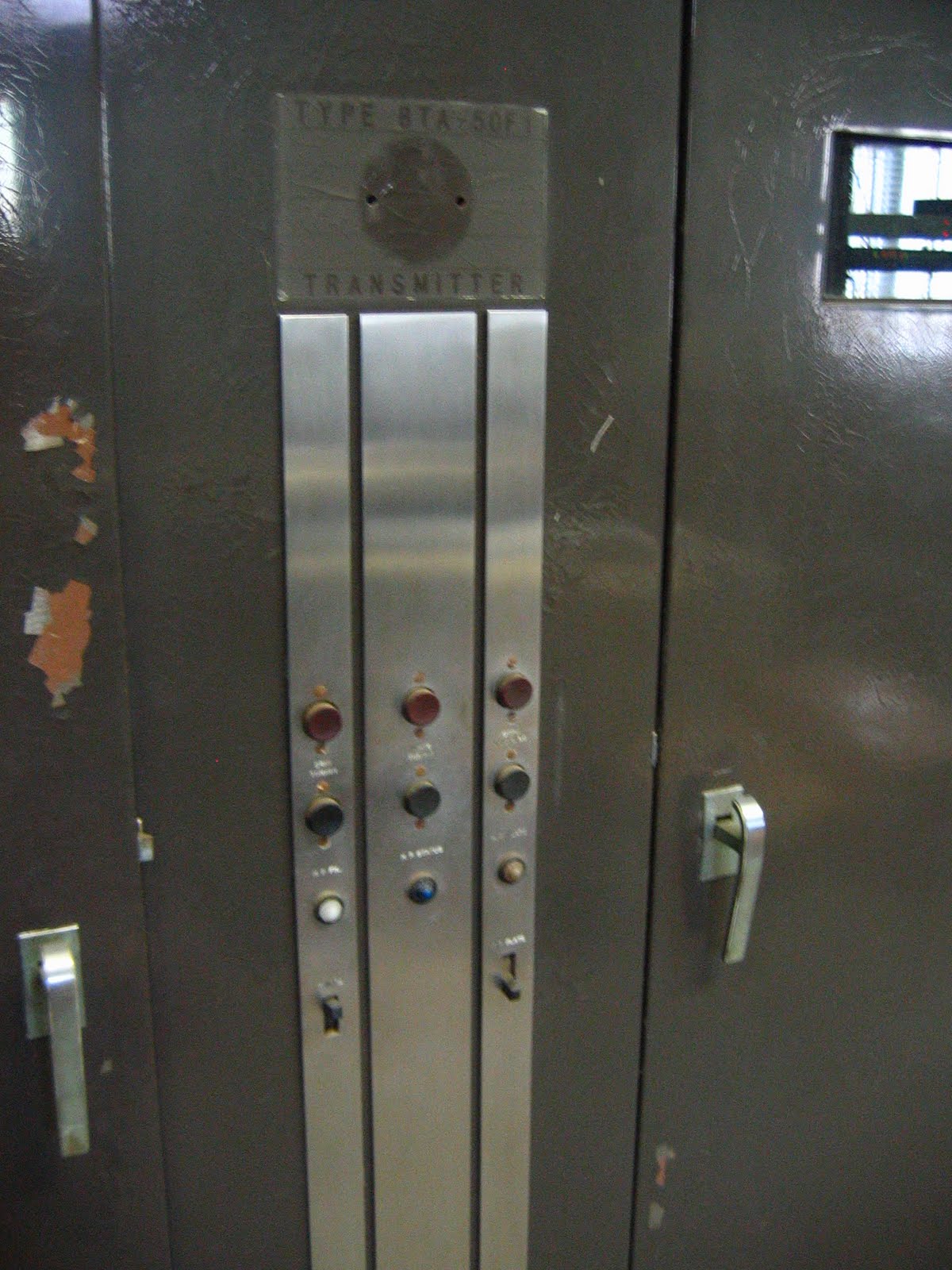
Sadly, the badge is missing in the next photo, but if you have zoom capabilities, you can see the imprint, which says, "TYPE BTA 50F 1 TRANSMITTER" and "RCA" should have been in the round spot:


There's much, much more to this historical tour, so please stay tuned!

Bud S. (staceys4@hotmail.com)

Friday, June 17, 2011

A Warehouse, New Orleans, LA Link!


Wow, I got an e-mail today, regarding The Warehouse, 1820 Tchoupitoulas Street, New Orleans, LA from Bob Wahl, who has a great website he wanted to share with us!

"I saw your post doing some research. Check out our site I think you might like it-bw"


http://www.blackstrat.net/warehouse/warehouse.html
 
I can't remember if I'd ever seen this before, or something similar...my mind is overflowing nowadays, BUT I just had to post it here (again), if I hadn't before.  There are some mp3 recordings there you can enjoy, of short clips and audio.  Lots of good stuff there to view, as well!
 
If you have ANYTHING Bob hasn't listed there, like posters, ticket stubs and other memorabilia regarding The Warehouse, please contact Bob at his links at the bottom of his website.
 
Thank you, Bob Wahl and technical guy/webmaster John Dubois!
 
Bud S. (staceys4@hotmail.com)

Thursday, June 16, 2011

My Trip To Little Rock: Tuesday, A Little More Geek Material

Yes, just blame this radio geek for all this stuff!  Jerry Sims has told me time and time again, "You technical guys understand that stuff!"  I hope this is not boring anyone, because THIS is radio history that will one day "go away" and we need to preserve and chronicle as much of this as possible.  Dave M. has comments in an upcoming post that will be interesting about the RCA BTA-50F1 transmitter that some (I) didn't know....

Do you ever wonder about those tubes?  Dave M. mentioned that they sat in ceramic sockets.  These tubes were 325+/- pounds and required a tube trolley to remove and replace them:


I almost grabbed that handle to see how heavy it was, not knowing I'd never budge it!

Here are more comments by Dave M.:

"There was a small trolley with a lift fork that we used to lift them off the porcelain "socket".

The "socket" was just a cylindrical porcelain thing that was connected to the forced air chamber (under the tube). The tube just "sat" on the porcelain mount in much the same way you take your morning constitutional. Forced cooling air was from bottom to top through the fins and then out the chimney in the top of the cabinet.

All connections were external using oversized thumbscrew clamp-like devices.
 
 
The filament voltage (was) - 11VDC @ 285A Yikes!
 
The photo is the RF power amplifier cabinet. Two tubes were active, and the other two were "spares". Notice that on the left side pair, the filament leads are only connected to one of the two tubes on that side. Same for the right half of the cabinet. If you had to change a tube on the fly, you could swing the leads over to the "spare" tube and get back on the air quickly. Then when you had time on maintenance night, you could lift out the dud using the mini forklift, and swap in a fresh tube.

The modulator cabinet had three tubes - two on line and one in-place spare."
 
Dave sent me a specification sheet, which is too large to print here; suffice it to say, at Class B operation, one tube utilized 15,000 volts with a DC input of 90,000 watts to produce 25,000 dissipation watts...that's watts output potential per tube!
 
Here is a spec drawing:
 
 
That is one tough tube!  I think Dave also mentioned to me that, what with those cooling fins around the tube and all the air rushing around them, they'd collect a little dust; Felix McDonald would actually pull the tubes and wash them to get the dirt/dust out of them!  I'll have to find that bit o' correspondence....
 
By the way, Dave also writes, "There is a FANTASTIC writeup and tour of the BTA 50F transmitter at this site. I highly recommend a read - it's a wealth of information!
 
http://www.j-hawkins.com/wknr.html

Here's a snapshot of the tube trolley I mentioned. (WGAR photo)":


You had to have all the tools of the trade to make things work...and KAAY enginners knew their business!  Thanks again, Dave!
 
Hang in there...we've got so much more!
 
Bud S. (staceys4@hotmail.com)

Wednesday, June 15, 2011

Console Comments From Greg Fadick, a.k.a. "Hot Scott Fisher"

Bud,

First of all, I can’t tell you how much I’m enjoying the posts on your trip through the KAAY transmitter site. While it’s really sad to see the condition of the facility, it’s also like visiting an old friend.

The picture of David B. with the Gates Yard console really brought back some memories. I have no idea where that was used at KAAY, as I never saw it there during my time, but I did spend many hours with my hands on one of those at other stations. Small, but a very sweet board.

The other console pictured (the one with David’s hand on top) is, if memory serves, an RCA 7A. It’s an early 60’s vintage board, but RCA continued to manufacture it through the 1980’s. We had a couple of those at KAAY during my tenure in ‘76-’77 at the Cottondale Lane studios. One was in the main KAAY control room, another in the large production studio, and maybe another one running around. Here’s a kind of interesting video of one actually working: http://www.youtube.com/watch?v=YQNcuhgu7nQ

As I said, RCA continued to sell this board through the 80’s, and in fact, we used one in the main control room at KLAZ during that time.

Again, if memory serves, the console in use in the main KAAY control room on 7th street, up until the move to Cottondale, was a Collins 212E. Here’s a link to some pics of one: http://forums.qrz.com/showthread.php?217533-Collins-212e-Console

Note the telephone style switches next to the pots on the bottom row. These selected program or audition. What made them unique was they moved vertically, with the up position being audition and down being program. On most consoles of the day these switches moved horizontally, to the left being audition, to the right, program. Again, I believe this is what was in the 7th Street studios, hopefully David B. and/or Dave M. can confirm that.

Keep those posts comin’. I’m loving them.

Thanks,

Greg

Tuesday, June 14, 2011

My Trip To Little Rock: Tuesday, Pickin' Around....

I had to almost run to catch up, especially when David B.'s thunderous voice beckoned!  I was almost breathless, nearly in tears, on the edge of laughter, as I continued to look around.  This was a very emotional day for all of us.

When I came around the corner, David B. had a console called, "The Yard" in his hands:


...and yes, it was a yard long!  I forgot to ask, but maybe this was a console for remote set-ups?  If you look on David B.'s right, you'll see more of the rectifier tubes in a rack, ready for service.  Also, if you look around him, you'll see the jumble; we had to be careful not to bark our legs against anything in storage.  We were pickin' through all kinds of stuff....

We went through the door behind David B. to find more stuff:


I remember David B. making the comment about something in this rack from WAKY (a sister LIN station in Louisville, KY).  I e-mailed him later and he mentioned Dave M. might comment on it...in the meanwhile, he said:

"The fourth box down in that picture was the Symmetra-peak I referred to a while back: the thing that decided whether the positive or negative peaks of incoming audio were hotter and "flipped things over" so the transmitter could act accordingly. I don't think it would have been very noticeable and/or important to anyone outside the station--and we didn't think about it very often."

Someone also mentioned that stuff got shipped around between the LIN stations as it was needed (or not?).  And Dave M.'s comments:

"From top to bottom here's what you have:

Top- An RCA calibrated line amplifier with "VU" meter panel and precision attenuator. The meter had a calibrated attenuator that allowed you to set the amplifier gain to suit its application. These were sometimes used to drive a telephone line to the transmitter from the studio, or to monitor the incoming audio. This is a pass through device.

Second from top- This is an RCA AM Modulation Meter. This was a required piece of FCC monitoring equipment, used to measure the percentage of modulation. It had to be calibrated yearly by a certified lab. It also had a "Peak" lamp that indicated 100% or higher. The FCC allowed peak modulation at 100% negative, and 125% positive modulation.

Third from top- A blank panel, probably used for for some type of project at one time.

Fourth from the top- A SymmetriPeak. This is an old audio processing device that helped insure the best possible peak versus average modulation (loudness). There are write-ups on this device on the web if you are interested in more info. It was a passive device, and had a really good set of input and output (audio) transformers in it.

Fifth from the top- A MARTI device. KAAY used MARTI microwave and MARTI STL (Studio-Transmitter link) radios, and this appears to be a MARTI changeover panel, when dual microwave receivers were used on a single receive dish. [NOT SURE OF THIS ONE!!]

Sixth from top- This looks like a cannibalized RCA audio amplifier of some sort.

Seventh from top- Another RCA audio amplifier with its front panel intact. Used as a utility line amplifier, controls were inside the drop down front panel.

Something you missed in the photo - the thing on the roll around cart behind the rack in the photo is one of the high power contactors for the BTA50F transmitter. This switch is the same type that Felix jimmied with a broom handle to keep it "latched" close in that great transmitter rescue story told several months ago on the blog.
 
DM"
 
(More of that particular story later!  bs)
 
There was a shout from downstairs, so we headed in that direction.  What a jumble.  Among the numerous things we found were several signifigant items:


A KTHS monitor speaker!  This picture was taken from across the room by me, while David B. held my high-output Fenix PD30 230-lumen LED flashlight on it.  It was so dark down there!  Only one light bulb for the whole downstairs, so I apologize for the grainy photo.  As many of you remember, KAAY came out of KTHS when LIN Broadcasting bought the station back in 1962, so this is a true relic of unknown year!
 
 
Now, David B. Treadway already has a voice that fills up all of Arkansas, but this manual reverb board made his, and others' voices, even more "boomy" over the air!  Some of you may remember us and A.J. Lindsey mentioning this reverb board and here is a link to A. J.'s blog about it:
 
http://kaay1090.blogspot.com/2007/07/kaay-reverb.html
 
David B. and I couldn't pick it up, so we slid it out of the alcove for this picture; it is in a steel frame and has a thin metal skin suspended in the frame.  There are two speakers behind it and the sampled audio made the board tremble.  I didn't see a mike pick-up on the other side, so I suppose someone suspended a mike somewhere around it.  That's Gordon Stephan in the background against the stairs.  Where he's pointing is a wall full of tapes we went through....


Just around the corner from where the reverb board was, was this console.  It is just like, or very, very similar to what Jerry mentioned he used in the studio back in '63-'67.  Again, sorry for the poor lighting by my LED flashlight, as there was NO lights back here.
 
More to come, don't touch that dial!
 
Bud S. (staceys4@hotmail.com)

Friday, June 10, 2011

My Trip To Little Rock: Tuesday With Dave M. Comments Continued

Such awesome power!  Not only in wattage output, but voltage and current input, as well...these magical machines ate it up and flamed it out!  More comments by Dave M.:


"OK gang, this is a busy photo with several interesting things to point out.

Most prominent in the middle is the "Y" looking thing. This is the main AC input to the rectifier stack.  You'll notice that the "wiring" at this point was all done with copper pipe, just like house plumbing. Except that very high voltages at high current went through these pipes. "Behind" the feed through you can see the rectifier stacks - most of them have been converted to solid state, eliminating the mercury vapor tubes.

In the near field, bottom left you can see the corner of a large steel enclosure. This is the choke for the power supply.

On the right near field, you can see another even larger metal enclosure with a pipe coming out of the top - - this is the modulation transformer weighing in at a nice trim 7,000 pounds. It is pretty much a conventional audio transformer, rated at about 35,000 watts average power handling capability. It sat in a tank of oil - the oil was used for cooling. In all the years working there, and as hard as we pushed the transmitter, I never felt the transformer tank running more than warm to the touch.

In the back of the photo to the left of the power feed through, and directly under the stack of boxes you can see a very small room with a bunch of black looking things. These were the control relays and circuit breakers for various operating sections of the transmitter. You could access these from the front of the transmitter when it was running - it is a "safe" room when the inside door is locked and the interlocks engaged. During normal operation, if a circuit breaker tripped, you would go into this room (from the front) to find out which circuit had tripped, and the CB could be reset from here. Each circuit breaker had a "flag" to indicate its status."

And, so far, that's Dave's tour...I think I sent him more photos for comment and I'm sure he'll have more to add later.  In the meantime, here are several more pictures of the transmitter and feedline areas:


This circuitry was on the backside of one of the doors I opened...
 
 
...and the inside of the same area, I believe.
 
 
This is a little different angle of the aforementioned relay and feedline Dave commented on...you can see some of the circuitry a little better.  There's David B. Treadway in the lower right-hand corner!
 
While my radio geek self was poking around in the transmitter David B. and Jerry were poking around all over, looking at stored items...more coming right up!
 
Bud S. (staceys4@hotmail.com)